Why You Eat
Healthy And Still
Can't Lose Weight.
Your food isn't the problem. Your understanding of it is. Here's what's silently wrecking your deficit every single day.

I have had this conversation more times than I can count. Someone walks into a session, frustrated, defeated, and completely confused. They tell me they eat clean. They cut out junk food. They drink water. They skip dessert most nights. And they still cannot lose weight.
They are not lying. They genuinely believe they are doing everything right. And honestly, they mostly are. The problem is not their food choices. The problem is that a handful of almonds, a drizzle of olive oil, some granola on their yogurt, and a piece of salmon just cost them 700 calories before dinner. And they had no idea.
This is not a discipline problem. It is not a metabolism problem. It is a knowledge problem. And it is fixable.
Your "Healthy" Snack Is Lying To You
Here is what a typical "healthy" afternoon looks like for a lot of people. No junk food. No soda. Just real, whole, nutritious food that most influencers would call clean eating.
Here is what that actually looks like in numbers.
None of those portions were exaggerated. That is a conservative estimate of what a normal day looks like when you are not paying attention.
This is why you are eating clean and not losing weight. Not because healthy food is bad. Because healthy food still has calories, and some of the healthiest foods on the planet are extraordinarily calorie dense.
Why Fat-Rich Foods Hit So Hard
Here is the thing nobody tells you about fat. It is not bad for you. Fat is an essential macronutrient. The problem is purely mathematical.
Fat carries more than twice the calories per gram of protein or carbohydrates. That means a small visual error on high-fat foods compounds fast. You underestimate your olive oil by one tablespoon and you just added 120 untracked calories. You grab a slightly bigger handful of nuts and there is another 80. Small errors, repeated across every meal, every day.
And it gets worse. Fat does not just carry more calories per gram. It also burns almost no energy to digest. Protein has a thermic effect of around 20 to 30 percent, meaning your body burns roughly a quarter of protein calories just processing it. Fiber is similar. Fat? About 2 to 3 percent. So not only does fat deliver more than twice the calories per gram, your body barely has to work to absorb it. That olive oil goes almost directly to your energy balance with zero friction.
To be clear: this is not an argument against eating fat. Fatty foods are not bad for you. Salmon, avocado, olive oil, nuts, and full-fat dairy are genuinely nutritious. The point is awareness of how much you are eating. To put it in perspective: a full cup of blueberries is 80 calories. One medium avocado is 320. Both are healthy. Both belong in your diet. But one of them requires a much closer eye on portion size.
You are not overeating on purpose. You just do not have the reference points to know when you are doing it. That is a fixable problem.
The foods most likely to quietly wreck your calorie budget: nuts, nut butters, granola, oils, full-fat dairy, fatty cuts of meat, avocado, and cheese. All real food. All genuinely nutritious. All requiring a closer eye than most people give them.
Four Steps To Fix It
None of this requires you to stop eating foods you love. It requires you to understand what you are eating well enough to make intentional choices. Here is how you build that skill.
MyFitnessPal is the starting point. Create a profile, enter your stats and goal, and let it give you a daily calorie target. The premium version lets you customize your macronutrient split, which matters because the right breakdown for you depends on what you enjoy eating and what keeps you full. High carb and low carb both work for fat loss when a calorie deficit is in place. Pick the one you can actually sustain.
While you are setting up your targets, prioritize protein. It protects muscle while you are in a deficit, keeps hunger in check better than carbs or fat, and takes more energy to digest. Shoot for 0.75 grams per pound of bodyweight as your daily floor.
Daily Protein Target
Multiply your bodyweight in pounds by 0.75. A 180-pound person needs roughly 135 grams of protein per day to protect muscle while losing fat. Set protein to 20 to 30 percent of your total calories in the app.
Meal frequency is one of the most argued-about topics in nutrition and also one of the least important. The total calories you eat across the day determine whether you lose fat. Not whether you eat three meals or six. Not whether you skip breakfast. Total calories.
Start with four meals a day, snacks included. If you feel stuffed after every meal, eat smaller meals more often. If you are constantly hungry, consolidate into fewer, larger ones. The goal is a structure that keeps you in your calorie target without misery.
Restricting too hard during daylight hours builds hunger pressure that explodes later. Total calories end up higher than if you had just eaten normally throughout the day.
Eat enough early in the day that you are not ravenous by evening. Predictable meals make it easier to stay on target without white-knuckling your way through hunger.
This is the step people resist the most. It feels obsessive. It feels like something only competitive bodybuilders do. But here is the actual goal: you are not weighing food forever. You are weighing food long enough to calibrate your eye so you never have to weigh it again.
Most people's visual estimates of portion sizes are off by 30 to 50 percent on high-calorie foods. That gap is the difference between losing weight and spinning your wheels for six months convinced something is wrong with your metabolism.
Weigh everything for two to four weeks. Estimate the portion first, then weigh it and see how close you were. Log it in MyFitnessPal. Over time your estimates sharpen. Once you can consistently land within 10 percent of the actual weight, you have built the skill. You can ditch the scale and trust your eye.
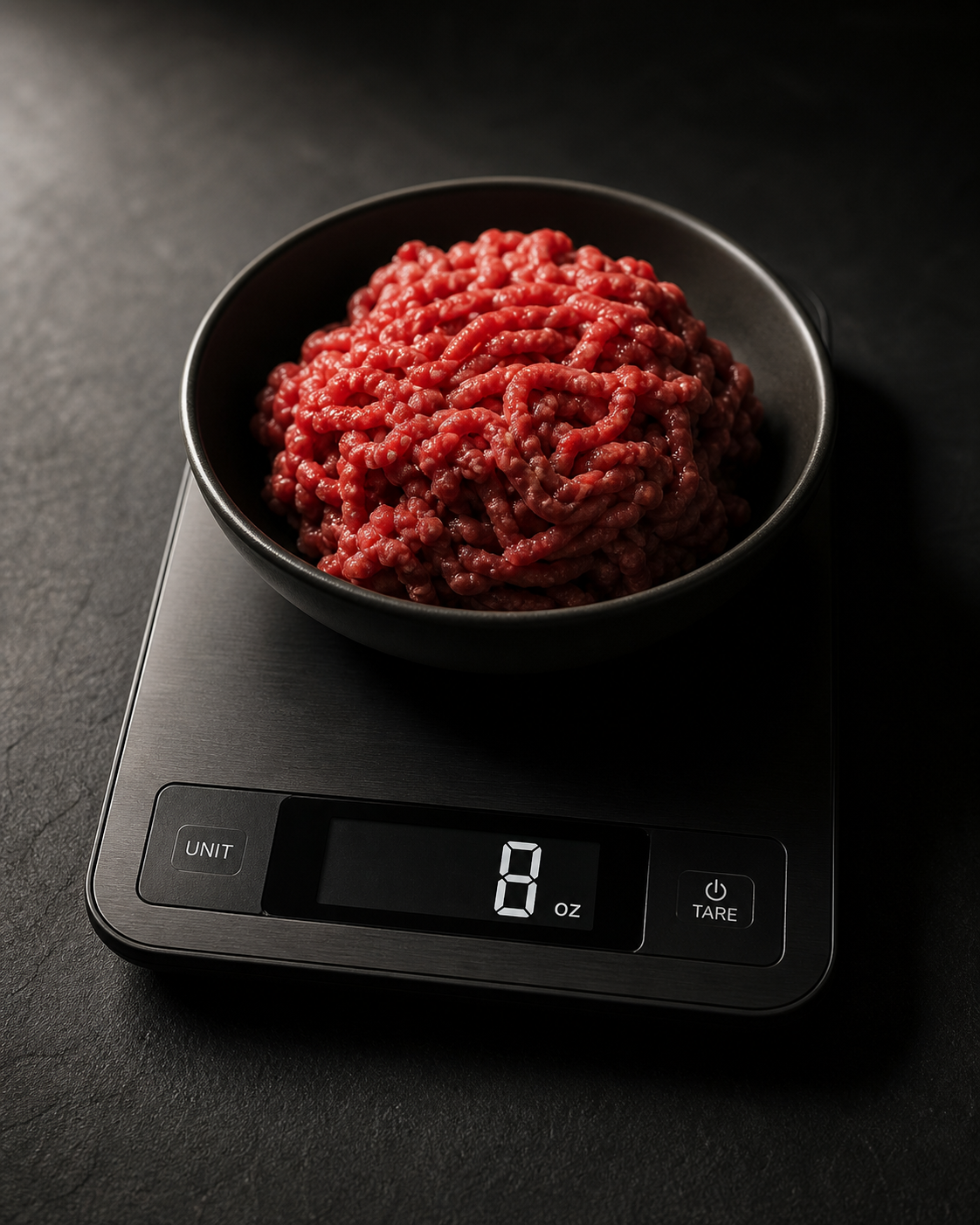
What you start with
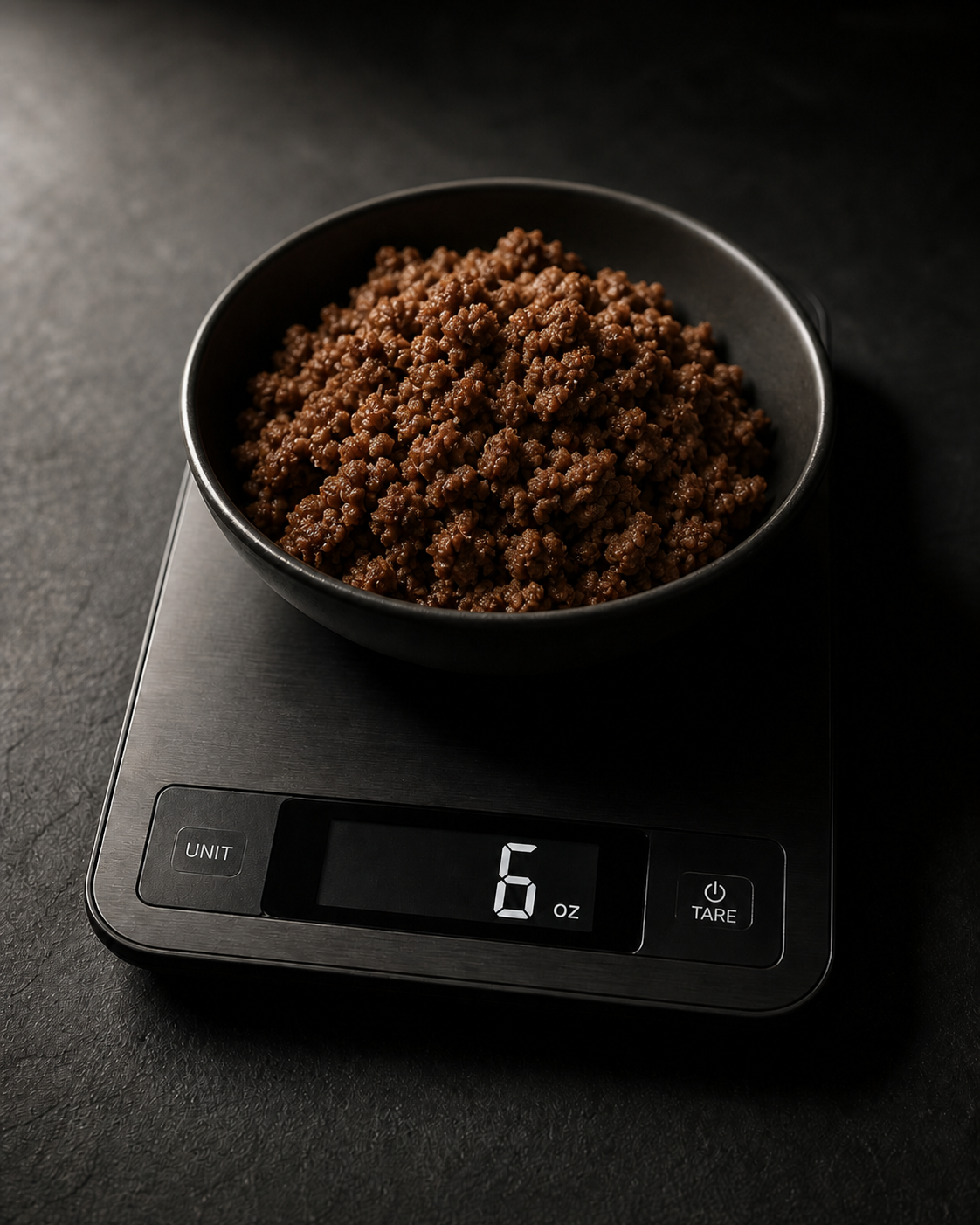
Same portion, less water and fat
Restaurants are not trying to keep you in a calorie deficit. They are trying to make food taste good. Fat and sugar make food taste good. So they use more of both than you would at home, and they do not measure anything.
Try to keep meals out to three or four per week while you are building this skill. On days you eat out, load your other meals with protein, vegetables, and fruit to bank calories for the restaurant. When in doubt, overestimate. You will almost never be wrong going that direction.
Calorie tracking is a skill. Skills require repetition before they become automatic. The first week of logging feels clunky. The second week feels less clunky. By week four you are logging meals in thirty seconds without thinking about it.
You will have days where you forget to log. Days where you blow your budget at a work dinner. Days where tracking feels like too much. That is normal and it does not undo your progress. The only thing that actually stops progress is quitting entirely.
The Bottom Line
You are not broken. Your metabolism is not broken. You have been eating healthy food without knowing what it actually costs you in calories, and that gap has been silently keeping you stuck.
Now you know why. And now you have the four steps to close the gap. Track your calories, hit your protein, weigh your food for a month, and give yourself time to build the skill. That is it. No special diet. No off-limits foods. Just awareness, applied consistently.
Most people who finally start seeing results do not change what they eat. They just stop guessing at how much.
Know someone who says they eat healthy but can't figure out why the scale won't move? Send them this article. It might be the most useful thing they read all week.
Want Someone To Figure This Out With You?
In-person coaching in Los Angeles or virtual coaching anywhere. Real programming, real accountability, real results.
Apply For Coaching- Gardner CD, et al. (2018). Effect of Low-Fat vs Low-Carbohydrate Diet on 12-Month Weight Loss. JAMA, 319(7), 667-679.
- Hill JO, Wyatt HR, Peters JC. (2012). Energy Balance and Obesity. Circulation, 126(1), 126-132.
- Longland TM, et al. (2016). Higher vs lower dietary protein during energy deficit combined with intense exercise. American Journal of Clinical Nutrition, 103(3), 738-746.
- Morton RW, et al. (2018). Systematic review of protein supplementation on resistance training-induced gains in muscle mass. British Journal of Sports Medicine, 52(6), 376-384.
- Leidy HJ, et al. (2015). The role of protein in weight loss and maintenance. American Journal of Clinical Nutrition, 101(6), 1320S-1329S.