
Improve Your Mental Health & Productivity
Journaling has become an integral part of my daily routine. Before I began this practice, I found it difficult to prioritize my needs for the day. My emotions would often dictate my actions and I would feel as if I were being pulled in multiple directions. I was quick to give in to cravings and equally quick to allow excuses to get in the way of my productivity.
Sound familiar?
Editor: Jason Desimone
Journaling has become an integral part of my daily routine. Before I began this practice, I found it difficult to prioritize my needs for the day. My emotions would often dictate my actions. I would feel as if I were being pulled in multiple directions. I was quick to give in to cravings and equally quick to allow excuses to get in the way of my productivity.
Sound familiar?
Before starting a workout with a client, I ALWAYS walk them through a warm-up as a means of preparing the body for the physical activity it is about to take part in. The philosophy of getting warmed-up can and should be applied to other aspects of our life as well. Even if you can roll out of bed and go straight into work, that doesn’t necessarily mean you are operating and an optimum level of performance.
Everyone is a bit different, but from experience, I know that most folks aren’t motivated to pop out of bed, drink lemon water, and get a workout in. Even I find it challenging to start my day this way. Instead of jumping right into the physical activity, I have found the most joy in a daily journaling routine using the “Five Minute Journal.”
I can only speak for myself, but I believe the best way to start the day is with a plan of action and setting attainable goals for the 24 hours ahead. For this reason, I find journaling to be one of the best tools to support mental health and productivity.
Journal
The 5-minute journal is six months long and is broken down into six sections. It was designed to be used in the morning and evening.
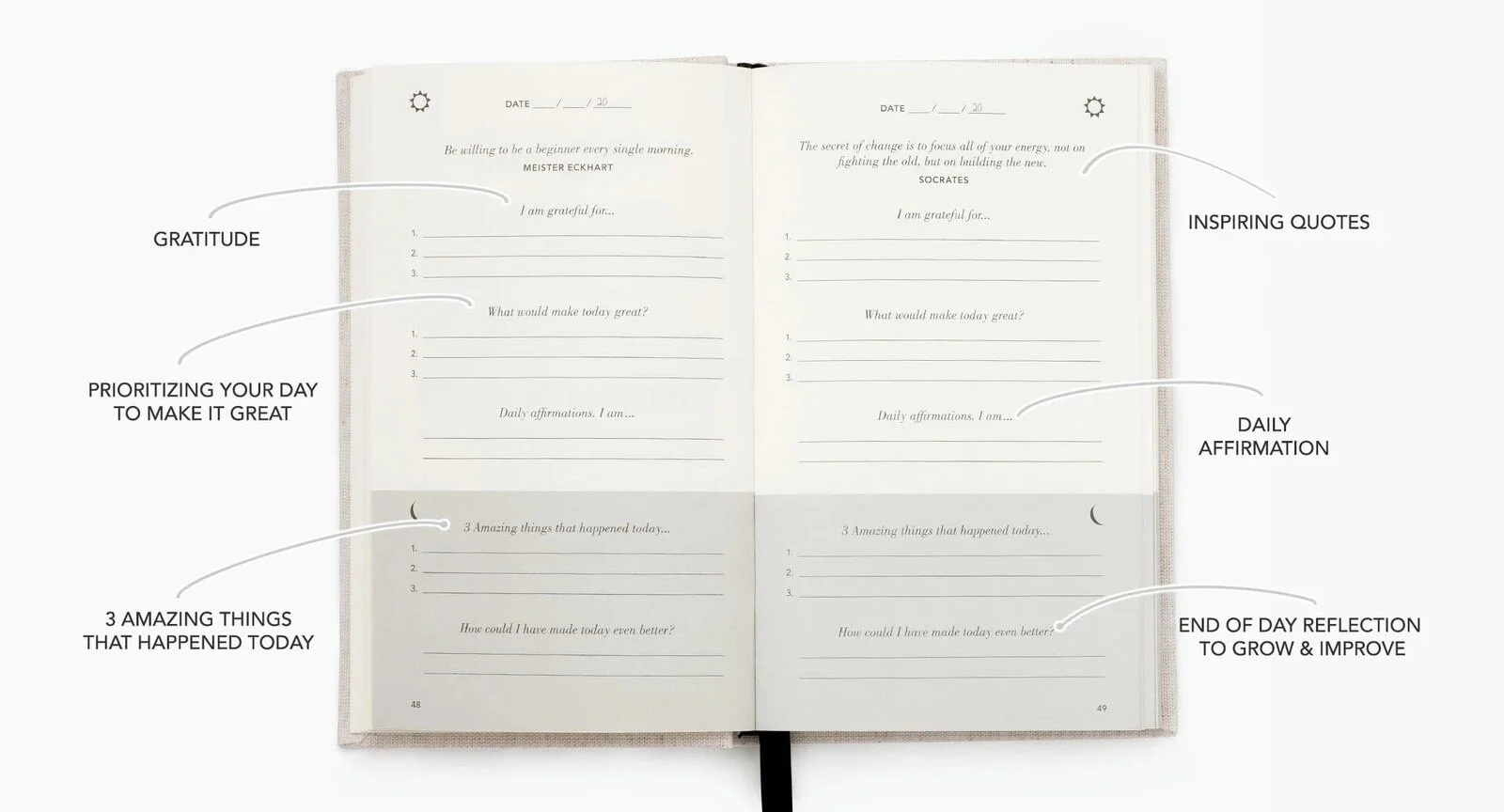
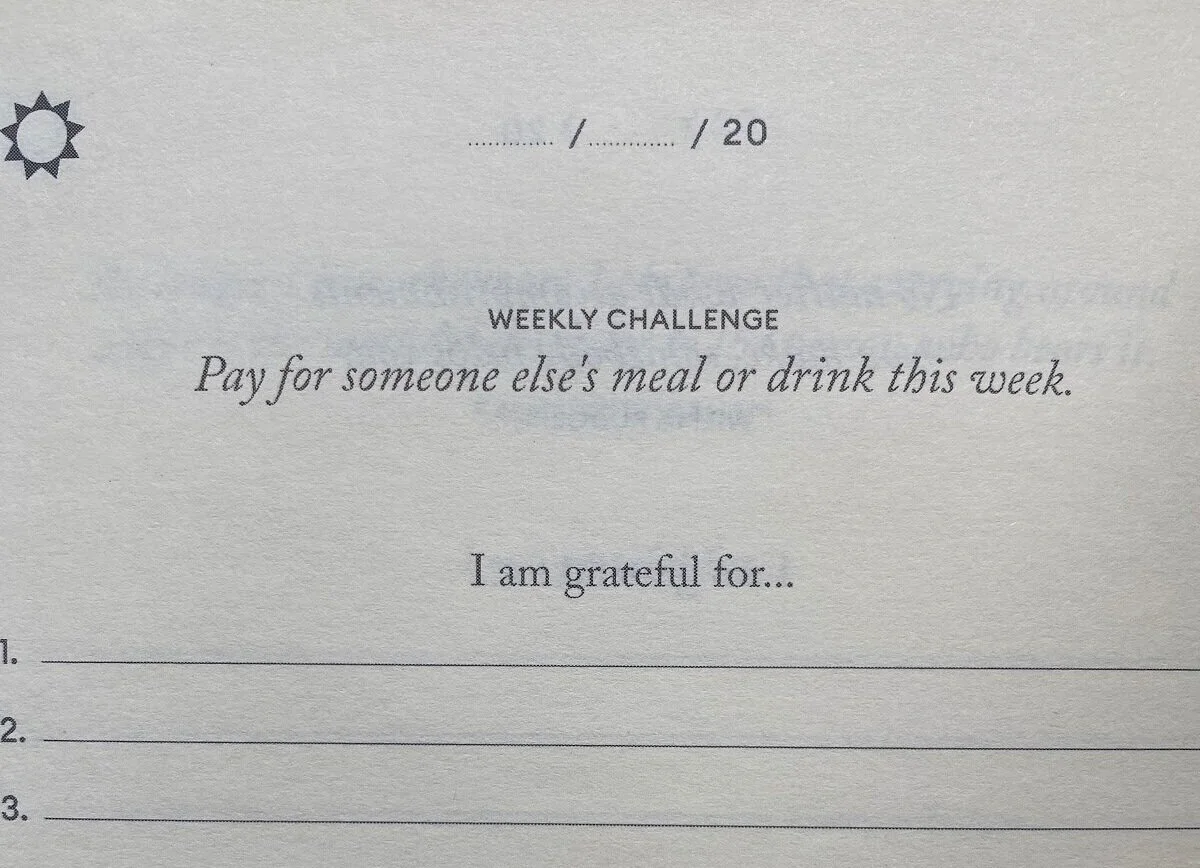
The journal starts with an inspirational quote, which serves as a shot of positivity. They are simple and sometimes cliche. But you will be surprised to see how well it works, especially on the days when you are dragging your feet. Also, there are fun daily challenges sprinkled throughout the journal (see below) to bring out the best in you.
Who is buying me lunch this week? =)
I Am Grateful For
While this may seem like a small or insignificant act, it has created much more space in my life for joy. It reminds me to appreciate the little things in life; a hot coffee after a sleepless night or a positive interaction with a stranger. A review of 91 studies found a daily gratitude practice boosted prosocial behaviors, i.e., helping others and sharing (1). Another review found an overall positive effect on well-being (2).
I believe a daily gratitude list is one of the best things you can do for happiness. In a world where we always compare ourselves to others, it can be easy to forget how lucky we are. Gratitude should be trained like a muscle; it requires daily repetition.
“Do not indulge in dreams of having what you have not, but reckon up the chief of the blessings you do possess, and then thankfully remember how you would crave for them if they were not yours.” -Marcus Aurelius
What Would Make Today Great?
I suffer from a made-up diagnosis called shiny object syndrome, also known as a millennial who grew up with social media. So instead of asking myself what would make the day great, I use this section as my to-do list. Usually, I plan out my daily goals the night before, so I don’t have to overthink in the morning.
A to-do list keeps me focused on the tasks that need to get accomplished for the day. When I don’t have a plan, I become a puppy around friends. My tail wags uncontrollably, and I can’t help but say hi to everyone.
My to-do list is an invaluable tool in keeping me on track and focused on what I need to accomplish each day. When I go into the day without a plan, I often find myself easily distracted and unable to identify which needs and tasks deserve the most attention.
Additionally, there is a great sense of accomplishment derived from crossing tasks off a list. It's kind of magical. When I put pen to paper to check off a job, I get a boost of energy and feel that small sense of victory. The small win builds momentum and motivation to complete the next task. It could be as simple as working out, reading ten pages in your book, or food shopping. There is power in planning out your goals.
Daily Affirmations. I Am…
I know. Affirmations can be very woo-woo. But research shows potential benefits to self-affirmations (3). There is power in putting pen to paper and affirming who you are that day, especially if you are trying to change behavior.
According to James Clear, author of Atomic Habits, changing your identity is the easiest way to change a habit. For example, if I need to write for 30 minutes that day. I write down: I am a writer who writes for 30 minutes without checking my phone. It seems silly, but trust me, it works!
Evening Reflections
The Five-Minute Journal has two evening prompts that I use to reflect on my wins and losses for the day. This evening audit serves as a great reminder of where I strived and where I need to be placing more attention and effort.
Before I had a regular journal practice, I found it very easy to blame others for my “bad luck” or shortcomings. It was difficult for me to acknowledge my failures because I felt this was a direct statement of my inadequacies. I was masking my fear with ego, which is a common yet unhealthy way to deal with these feelings.
Furthermore, when we let ego take over, we are left thinking we are better than we are, leaving little room for improvement.
“The man who believes he knows everything stands to learn nothing.”
I know I am not alone in this behavior. I have seen this firsthand with my clients’ successes and failures. As a trainer, I have heard every excuse in the book to follow a healthy diet. I have learned that the clients who saw the best results were the ones who were able to take ownership of their mistakes. It wasn’t easy for them, but it allowed them to see where they went wrong. Once they identified their errors, they were able to get back on track.
When we don’t accept our mistakes, we don’t allow ourselves to learn from them. We need to be honest with ourselves daily to see where we can improve. Don’t be like my younger self and be blinded by your ego. It has taken me some time, but I have learned to take ownership of my mistakes through journaling. I believe the five-minute journal has played a considerable role in my success. And I think it can do the same for you too.
“Every day and night keep thoughts like these at hand--write them, read them aloud, talk to yourself and others about them.” - Epictetus
References
Ma, L. K., Tunney, R. J., & Ferguson, E. (2017). Does gratitude enhance prosociality?: A meta-analytic review. Psychological Bulletin, 143(6), 601–635. https://doi.org/10.1037/bul0000103
Sansone, R. A., & Sansone, L. A. (2010). Gratitude and well-being: the benefits of appreciation. Psychiatry (Edgmont (Pa. : Township)), 7(11), 18–22.e
Epton, T., Harris, P. R., Kane, R., van Koningsbruggen, G. M., & Sheeran, P. (2015). The impact of self-affirmation on health-behavior change: a meta-analysis. Health psychology: official journal of the Division of Health Psychology, American Psychological Association, 34(3), 187–196. https://doi.org/10.1037/hea0000116

28 Years Old: 10 Life Lessons
Over the years, I have come to realize the importance of principles. As humans, we struggle to do the right thing when the wrong choice is the easier thing to do. We have all been in situations where we know what to do, but we do a more satisfying thing. You aren't weak-minded; you are just human.
The key to overcoming this human fallacy is to have external rules or principles to hold you accountable. When I was 24 years old, I wrote down ten lessons that I learned over my lifetime. I repeated the process last year while traveling to Nice from Paris. It was a five-hour train ride, and I needed something to do to pass the time. The rolling green hills provided the perfect scenery to reflect on life. By the end of the trip, I had updated my ten life lessons.
Over the years, I have come to realize the importance of principles. As humans, we struggle to do the right thing when the wrong choice is the easier thing to do. We have all been in situations where we know what to do, but we do a more satisfying thing. You aren't weak-minded; you are just human.
The key to overcoming this human fallacy is to have external rules or principles to hold you accountable. When I was 24 years old, I wrote down ten lessons that I learned over my lifetime. I repeated the process last year while traveling to Nice from Paris. It was a five-hour train ride, and I needed something to do to pass the time. The rolling green hills provided the perfect scenery to reflect on life. By the end of the trip, I had updated my ten life lessons.
Today I turn 28 years old. 2020 has been filled with ups and downs, from a lost friend and family member to starting my own business. It has been a challenging year for all of us. So I am revisiting the lessons all over again. I was shocked to see how many teachings I had forgotten; principles that could have saved me from self-inflicted trouble and worry. The pandemic isn’t going away anytime soon. So I hope my ten lessons can help you during these difficult times.
#1 Don’t Look At Your Phone Upon Waking
It is a simple rule that has had a profound effect on my day. I wake up around 430am most mornings and don’t look at my phone until work starts at 5:15 am. Each morning begins with a glass of water and meditation, followed by homemade coffee and journaling. I enjoy the quiet mornings. I can reflect on my life in peace with zero distractions from my phone.
#2 Practice Gratitude
My parents told me to be grateful for everything we had. But I could never grasp the concept of gratitude until I started journaling. I started using the 5 Minute Journal four years ago. Currently, I am on my 8th one. Each morning, it asks you to write down three things of gratitude. The act may seem small and a waste of time, but it has made life more enjoyable.
Journaling reminds me to appreciate the little things in life; a hot coffee after a sleepless night, a smile from a cute girl, or a beautiful day. In a world where we always compare ourselves to others, it can be easy to forget how lucky we are. It is essential to understand that gratitude is a muscle; it requires daily repetition. We must train ourselves to appreciate the food, water, and shelter we use every day. The 5 Minute Journal is an excellent place to start. (ORDER HERE)
“Do not indulge in dreams of having what you have not, but reckon up the chief of the blessings you do possess, and then thankfully remember how you would crave for them if they were not yours.” -Marcus Aurelius
#3 Choose Your Friends Wisely
Friendships can have a massive impact on one's life, especially during a pandemic, when human interaction is limited. The people we are with most influence our thoughts, decisions, and behaviors. For example, a study of 12,000 people found a 57% increase in obesity risk after a close friend became obese (1).
Friends bring out the best or the worst in us. I have found that certain friends can keep me motivated and focused on my goals, whereas others knock me off course. We are creatures of habit and mimic others around us. Therefore, we need to surround ourselves with smart, honest people who will let us know when we step out of line.
#4 Practice Meditation
For the past six years, I have used Headspace, a guided meditation app. It has helped me control my anxiety and not be a slave to my emotions. It has been shown to improve stress, anxiety, depression, and quality of life (2). A common misconception about meditation is the absence of thoughts. The purpose of meditation is to strengthen the ability to focus on one thing and not let thoughts distract us. Your thoughts are ideas that pop into the mind. They may persuade us to do certain things, but they don't control us.
You must train the mind to become less reactive to these feelings. It starts with sitting still and paying attention to the breath. The goal is to observe the thoughts and not get attached to the stories in our heads. After you acknowledge the idea, come back to the breath. Like any skill, it takes time to learn, but it is worth the effort.
#5 Take Extreme Ownership Through Journaling
It seems so simple, but I struggled with this for the longest time. I would continuously blame others for my “bad luck” or lack of opportunities in the past. I would never admit to my failures or flaws because I was afraid of being seen as inadequate. I masked this fear with an ego that deceived me and made me think I was better than I was. But I have come to my senses and realized that it was my fault and no one else's.
I know I am not alone in this behavior. I have seen this firsthand with my clients’ successes and failures. As a trainer, I have heard every excuse in the book when it comes to following a healthy diet. I have learned that the clients who saw the best results were the ones who were able to take ownership of their mistakes. It wasn’t easy for them, but it allowed them to see where they went wrong. Once they identified their errors, they were able to get back on track.
When we don’t accept our mistakes, we don’t allow ourselves to learn from them. We need to be honest with ourselves daily to see where we can improve. I have found journaling to be a useful tool for reflecting. I journal every morning and night, looking over the wins and losses of the day. My journals hold me accountable to my goals and have helped me become the best version of myself.
“Every day and night keep thoughts like these at hand--write them, read them aloud, talk to yourself and others about them.” - Epictetus
#6 Be First
As a trainer, you must have the ability to talk to people and build rapport with them. You have to be personable if you want to be successful. But throughout my life, I have always struggled to talk to strangers. So I had a decision to make, either overcome my shyness and fear of rejection or find a new job. Luckily, I came across the Tim Ferriss Podcast, where his guest, Gabrielle Reece, stated that her life mantra was “to be first.”
Since hearing this mantra, I have done my best to adopt it, and it has changed my life. The mantra gives me a sense of control in my life that I have never felt before. It gives me the courage to offer advice or ask for help from others. But it hasn’t been easy. In the beginning, I would stutter my words and talk too fast. I felt embarrassed but proud of myself for trying.
Each time I practiced the mantra, I became better and better. My words became more precise and smoother. I slowly started to develop confidence in myself that I didn’t know existed.
Nowadays, it is harder to go first. The masks and the pandemic have made it challenging to talk to others. But I implore you to go ahead and give it a try tomorrow. Strive to be the person who provides a friend with a compliment or a smile. You will be surprised by the power going first has on your life and other people.
#7 Go For A Hike
The Coronavirus pandemic has caused the world to come to a halt, increasing anxiety and stress levels with it. We must find a way to cope with the chaos that is life. For me, hiking has been just that. At the end of each hike, my mind and body are relaxed and content. The mindless chatter is quieted. I am at peace with myself and others. For me, hiking is therapy. I know it sounds like pseudoscience, but there’s research to back these experiences.
Forest bathing, also known as Shinrin-yoku, is a common practice in Japan where you take in the forest atmosphere through all of your senses. The simple method of exposing yourself to nature has been shown to do the following (3):
Reduced stress levels
Reduced blood pressure
Reduced heart rate
Improved immune function
I highly recommend being in nature once a week. If you don’t have any trails nearby, then go for a walk through a park. Do your mind and body a favor, bathe in the forest air.
#8 Listen More, Talk Less
“We have two ears and one mouth so that we can listen twice as much as we speak.”-Epictetus
I have been very successful at meeting people throughout my career and turning them into my clients, but it was not due to my ability to talk; instead, it was due to my listening. Active listening is so simple but can have the most significant impact on a person’s life. Unfortunately, we hardly ever listen because our ideas and desires consume us. These thoughts don’t allow us to listen to the person in front of us.
Don't think about the next thing you will say. Just focus on the person in front of you and actively listen. Once they finish, let the awkward silence work its magic. Take a moment to think before you speak and then respond accordingly. Usually, the person will figure it out on their own, and when they figure it out themselves, it tends to stick better.
In a world where everyone is fighting to be heard, you can be the person who gives them that voice. Every single person in this world is craving to feel appreciated. The only way to make them feel important is through listening.
#9 Find A Mentor
“Surely it is of great use to a young man, before he sets out for that country, full of mazes, windings, and turnings, to have at least a general map of it, made by some experienced traveler.”- Lord Chesterfield to his son
I can't stress this one enough; finding a mentor or teacher to model has been the key to my success as a personal trainer. I entered the field as a blank slate at 19 years old. But I went out of my way to learn from the best in the business. I mimicked what they did and put my little spin on it.
Most likely, someone has already achieved the thing you want, so take the time to find out who that person is and learn from them. The person can be online or in-person; it doesn't have to be one or the other. Some of my mentors are Tim Ferriss, Ben House, Eric Cressey, Mike Robertson, Ryan Holiday, and Joe Rogan. I have never met any of them, but I have read their blogs, books and listened to their podcasts daily.
“Absorb what is useful, reject what is useless, add what is essentially your own.”-Bruce Lee
#10 Read The Book Again
Information bombards us today. There will always be another book to read or podcast to listen to. Instead of continually seeking new knowledge, aim to relearn previous lessons. Go back and reread the book. Some of my most significant insights have come from books that I have reread over the last few years. Here are a few that I highly recommend for personal growth:
Breath
The Molecule Of More
The Obstacle Is The Way
As Bruce Lee says, “I fear not the man who has practiced 10,000 kicks once, but I fear the man who has practiced one kick 10,000 times.” And that is why I revisit my principles every year. It teaches me to focus on the few things that matter the most. Remember, less can be more.
References
Christakis, N. A., & Fowler, J. H. (2007). The spread of obesity in a large social network over 32 years. The New England journal of medicine, 357(4), 370–379. https://doi.org/10.1056/NEJMsa066082
Gotink, R. A., Meijboom, R., Vernooij, M. W., Smits, M., & Hunink, M. G. (2016). 8-week Mindfulness Based Stress Reduction induces brain changes similar to traditional long-term meditation practice - A systematic review. Brain and cognition, 108, 32–41. https://doi.org/10.1016/j.bandc.2016.07.001
Song C, Ikei H, Miyazaki Y. Physiological Effects of Nature Therapy: A Review of the Research in Japan. Int J Environ Res Public Health. 2016;13(8):781. Published 2016 Aug 3. doi:10.3390/ijerph13080781
10 Day Headspace Challenge
Meditation dates back to the first century and has been practiced for thousands and thousands of years. It has been shown to improve stress, anxiety, depression, and quality of life (1). A common misconception about meditation is the absence of thoughts. The goal is not to stop thinking; if you did, you would be dead.
The purpose of meditation is to strengthen the ability to focus on one thing and not let thoughts intervene. Our thoughts are not facts; they are just ideas that pop into the mind. They may persuade us to do certain things, but they don't control us. To become aware of this process, you must train the mind to become less reactive. One of the best ways to do this is by sitting and paying attention to the breath.
“The mindfulness meditation exercises focus on paying attention to bodily sensations, emotions, and thoughts while embracing a non-judgemental, accepting attitude towards whatever arises until it passes away(2).”
What Is Meditation?
Meditation dates back to the first century and has been practiced for thousands and thousands of years. It has been shown to improve stress, anxiety, depression, and quality of life (1). A common misconception about meditation is the absence of thoughts. The goal is not to stop thinking; if you did, you would be dead.
The purpose of meditation is to strengthen the ability to focus on one thing and not let thoughts intervene. Our thoughts are not facts; they are just ideas that pop into the mind. They may persuade us to do certain things, but they don't control us. To become aware of this process, you must train the mind to become less reactive. One of the best ways to do this is by sitting and paying attention to the breath.
“The mindfulness meditation exercises focus on paying attention to bodily sensations, emotions, and thoughts while embracing a non-judgemental, accepting attitude towards whatever arises until it passes away(2).”
Does Meditation Work?
A review of 209 studies found mindful-based therapies to reduce stress, depression, and anxiety (3). Another review of 29 studies found similar results in healthy individuals (4). Plus, meditation has been shown in 18 studies to be useful for weight loss in overweight and obese individuals (5). But in most of these studies, the practice was structured in a classroom setting with a teacher. The eight-week standard mindfulness-based stress reduction protocol is listed below (6):
26 hours of in-class training through 8 weekly group classes (1.5-2.5 hours/class) plus one 6 hr. class during the 6th week
Home practice (45 min/day 6 days/wk or 36 hours over 8 wks)
Whole group reflection/sharing
The protocol is not easy. It is time-consuming and mentally demanding. The majority of people do not have the time available or the resources to perform an 8-week protocol. So if you can’t meditate 45 minutes per day, what should you do?
Enter Headspace
I have always been stubborn and afraid of change, so I was very reluctant to give meditation a try. In the past, I have struggled with anxiety and tried to do meditation, but I never stuck with it. I lacked the accountability to create a routine. I needed something to hold me accountable. Headspace was the perfect fix. After the ten-day challenge, I was hooked. I bought the year membership and haven’t looked back.
Over the last six years, I have completed over a thousand sessions. I haven’t been perfect with my morning meditation. I have missed some days due to a lack of discipline, but I don’t let that deter me. You are going to make mistakes and miss days.
At times, meditation will be boring, and you will hate every second of it. But if you can stick with it, you will experience a sense of control like never before. Anecdotally, I have experienced a deeper focus and fewer distractions. I am learning to be less reactive to my emotions. I am not the only one experiencing these benefits. There have been at least four studies that have shown the Headspace app to be an effective tool at reducing perceived stress and mind-wandering. Also, focus and general well-being improved too (7-10).
(7-10).
I understand that starting a new routine can be challenging, especially in the morning. The hardest part of any training is getting started, and meditation is no different. But it is much easier to achieve when you have a goal and someone holding you accountable. So join me and the millions of others on Headspace for your ten-day challenge.
*You can get the app at headspace.com, the Google Play Store, or the Apple App Store. (Seriously, give it a try.)
References
Gotink, R. A., Meijboom, R., Vernooij, M. W., Smits, M., & Hunink, M. G. (2016). 8-week Mindfulness Based Stress Reduction induces brain changes similar to traditional long-term meditation practice - A systematic review. Brain and cognition, 108, 32–41. https://doi.org/10.1016/j.bandc.2016.07.001
Shapero, B. G., Greenberg, J., Pedrelli, P., de Jong, M., & Desbordes, G. (2018). Mindfulness-Based Interventions in Psychiatry. Focus (American Psychiatric Publishing), 16(1), 32–39. https://doi.org/10.1176/appi.focus.20170039
Khoury, B., Lecomte, T., Fortin, G., Masse, M., Therien, P., Bouchard, V., Chapleau, M. A., Paquin, K., & Hofmann, S. G. (2013). Mindfulness-based therapy: a comprehensive meta-analysis. Clinical psychology review, 33(6), 763–771. https://doi.org/10.1016/j.cpr.2013.05.005
Khoury, B., Sharma, M., Rush, S. E., & Fournier, C. (2015). Mindfulness-based stress reduction for healthy individuals: A meta-analysis. Journal of psychosomatic research, 78(6), 519–528. https://doi.org/10.1016/j.jpsychores.2015.03.009
Carrière, K., Khoury, B., Günak, M. M., & Knäuper, B. (2018). Mindfulness-based interventions for weight loss: a systematic review and meta-analysis. Obesity reviews : an official journal of the International Association for the Study of Obesity, 19(2), 164–177. https://doi.org/10.1111/obr.12623
Vago, D. R., Gupta, R. S., & Lazar, S. W. (2019). Measuring cognitive outcomes in mindfulness-based intervention research: a reflection on confounding factors and methodological limitations. Current opinion in psychology, 28, 143–150. https://doi.org/10.1016/j.copsyc.2018.12.015
Kirk, U., Wieghorst, A., Nielsen, C.M., Staiano, W. (2019) On-the-Spot Binaural Beats and Mindfulness Reduces Behavioral Markers of Mind Wandering. J Cogn Enhanc 3, 186–192 https://doi.org/10.1007/s41465-018-0114-z
Bostock, S., Crosswell, A. D., Prather, A. A., & Steptoe, A. (2019). Mindfulness on-the-go: Effects of a mindfulness meditation app on work stress and well-being. Journal of Occupational Health Psychology, 24(1), 127–138. https://doi.org/10.1037/ocp0000118
Champion, L., Economides, M., Chandler, C. (2018) The efficacy of a brief app-based mindfulness intervention on psychosocial outcomes in healthy adults: A pilot randomized controlled trial. PLOS ONE 13(12): e0209482. https://doi.org/10.1371/journal.pone.0209482
Yang, E., Schamber, E., Meyer, R., & Gold, J. I. (2018). Happier Healers: Randomized Controlled Trial of Mobile Mindfulness for Stress Management. Journal of alternative and complementary medicine (New York, N.Y.), 24(5), 505–513. https://doi.org/10.1089/acm.2015.0301

Train Against Gravity
My whole life I have struggled to fit in. Insecurities, childhood trauma, and the urge to be someone else plagued me. I would be lying if I said these fears are gone. But I am learning how to overcome them through stoic philosophy and training. And that is why I created Train Against Gravity. The goal is to teach you these principles through movement, meditation, and journaling.
"What man actually needs is not a tensionless state but rather the striving and struggling for a worthwhile goal, a freely chosen task. What he needs is not the discharge of tension at any cost but the call of a potential meaning waiting to be fulfilled by him.”- Viktor Frank
My whole life I have struggled to fit in. Insecurities, childhood trauma, and the urge to be someone else plagued me. I would be lying if I said these fears are gone. But I am learning how to overcome them through stoic philosophy and training. And that is why I created Train Against Gravity. The goal is to teach you these principles through movement, meditation, and journaling.
It is human nature to seek comfort and the least path of resistance. It will feel pleasurable at the moment. But a mindset of instant gratification will eventually lead you down a deep dark hole, where numbness is your only friend. I have been there before. I can still remember the cold sweats running down my body as I lost every single dollar in my bank account. Through these setbacks and depressions, training has been there for me.
I am an addict, a dopamine junkie. Training fills the void and gives me the adrenaline I need to survive. I am not sure if I would be here today if it wasn't for the endorphins and sense of accomplishment exercise gives me. But training doesn't have to take place in a gym. You don't need tools to get in shape, yes they can help, but they aren't essential. Gravity is everywhere. Thus, you can train anywhere at any time. And just like you have to pay taxes, you must train. Be it physical or mental, to live a meaningful life there must be adversity. You shouldn't run from challenges, rather, you should embrace and learn from them. Gravity is the obstacle in the way, and you must not run from fear, you must confront it.
Meditation Strengthens The Brain
The mind and body are quite similar. When you stop training a muscle it becomes weaker. And since the brain is a muscle, it requires training to keep in shape. Now, I am not just talking about physical exercise, we must include some type of mental exercise too. After all, if you don’t use it, you will lose it.
The mind and body are quite similar. When you stop training a muscle it becomes weaker. And since the brain is a muscle, it requires training to keep in shape. Now, I am not just talking about physical exercise, we must include some type of mental exercise too. After all, if you don’t use it, you will lose it.
In a previous post, I talked about meditation and how it helped improve my productivity as a trainer. Over the years I have heard that meditation can help increase focus and slow down aging. I became curious and wondered how meditation affected the brain. It turns out that meditation physically changes the brain by increasing its gray matter.
The brain has two types of matter: gray and white. According to Wikipedia, gray matter is responsible for the following: muscle control, and sensory perception such as seeing and hearing, memory, emotions, speech, decision making, and self-control. While the white matter is responsible for connecting different regions of gray matter together.
Now, I don’t want you to think one is more important than another. Both regions play a crucial role in mental health. In fact, the open access peer-reviewed journal BMC Psychiatry found that adults with a generalized anxiety disorder had less white matter than healthy subjects (1). So, we can’t just try to strengthen our gray matter and leave out the white matter. Luckily, meditation strengthens both areas.
For many years scientists thought that you couldn't change the brain and the regions inside of it. But we now know that the brain is plastic and will adapt to the stimulus you give it. But the brain does weaken with age, losing its ability to focus on a task (2). So, time is of the essence.
Can You Slow Down Aging?
Scientists from Emory University wanted to see whether or not meditation could slow down this mental decline. So they performed a study that compared 13 practitioners of Zen meditation versus 13 non-practitioners. When looking at brain images of the two they found that the meditators had increased levels of gray matter in the brain, especially in areas that are responsible for attention processing.
The authors stated,
“While control subjects displayed the expected negative correlation of both gray matter volume and attentional performance with age, meditators did not show a significant correlation of either measure with age (2).” The authors concluded that meditation may have a neurotrophic effect on the brain and could potentially slow down the aging process (2).
Another study, done by the Department of Psychology at Emory University found similar results. The study included 14 healthy adults from local Atlanta meditation communities who have more than a year of meditation experience. The authors compared high experienced meditators versus low experienced meditators. The authors found the following,
“Participants with more meditation experience exhibited increased connectivity within attentional networks, as well as between attentional regions and medial frontal regions.”
The study shows that meditation may help maintain attention and improve the ability to disengage from distraction(3). Granted, both studies have small sample sizes, so you have to take it with a grain of salt. However, I have also experienced these benefits. Over the last four years, my focus and productivity have improved drastically. But remember, meditation is not about stopping your thoughts.
The purpose is to learn how to become aware of thoughts and to not let them control you. Meditation will teach you how to control your emotions instead of being controlled by them. It will help you become the master, instead of the slave.
*You can get the headspace app and the 10-day challenge free at headspace.com, the Google Play Store, or the Apple App Store. (Seriously, give it a try.)