Increase Strength With Double Progression
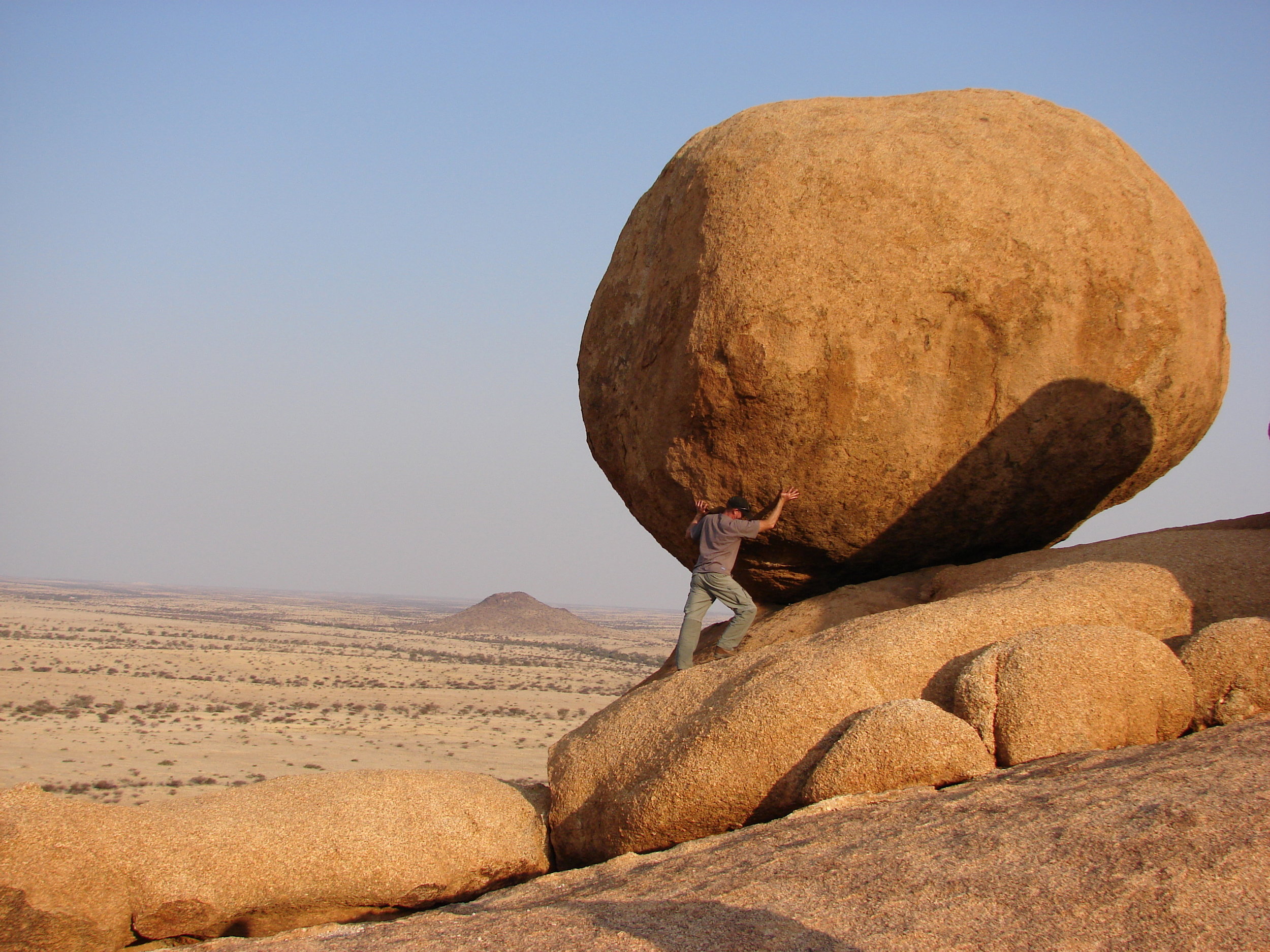
In the 6th century, there was a famous Croton wrestler known for his strength and size. As the story goes, Milo lifted a calf onto his shoulders every day. As the calf grew, so did Milo’s strength and size. The once small calf was now a full-grown bull, and the skinny boy was now a jacked dude carrying around this massive beast. Believe it or not, there is a technical term for this type of training; it’s called “Progressive Overload.”

In the 6th century, there was a famous Croton wrestler known for his strength and size. As the story goes, Milo lifted a calf onto his shoulders every day. As the calf grew, so did Milo’s strength and size. The once small calf was now a full-grown bull, and the skinny boy was now a jacked dude carrying around this massive beast. Believe it or not, there is a technical term for this type of training; it’s called “Progressive Overload.”
In short, by increasing the weight and the demand on your muscular-skeletal system, you will increase your gains in muscle size, strength, and endurance. So all you need to do is keep upping your weight and upping your reps. And in no time you’ll be as jacked as Milo...right?
Well, it’s not quite that simple. If you were able to increase your overall strength every time you lifted heavier weights, you’d have hulk-like power by now. I’m guessing you haven’t lifted any cars over your head lately, so let’s dive a little deeper and take a journey back to my early days of strength training.
Baby Erik
In the 8tth grade, I was your typical skinny, athletic guy. Despite playing sports and doing the occasional set of push-ups, I had yet to lift any weights. That all changed the following summer when I joined the gym with my oldest brother. I fell in love with the gym and lifted every day that summer.
At this point, I didn't have a structured training program, but I was increasing the weights and workload daily. In three short months, I went from being a scrawny kid to a jacked bro being accused of taking steroids! Those early days are still some of my fondest memories in my strength training journey. Sadly, this type of rapid growth will likely only happen once or twice in a lifter’s career due to the law of diminishing returns.
Although progress may come very quickly for beginners, that’s not going to be the case for everyone. Results will come in waves. We will often face plateaus and periods of stagnation. The best way to bypass this phenomenon is to implement an exercise program based on a method called “double progression.”
Double Progression
Chances are you aren’t going to up your loads every workout, but you may very well be able to squeeze out additional reps at the same weight. This is why I’m a big proponent of the double progression model. It allows you to experience small wins that may have been missed if you just focused on weight alone.
For example, if an exercise called for three sets by five to seven reps. You should start on week one with a weight that is challenging for five reps. Once you can do three sets by five reps, you increase the reps until you can hit three sets by seven reps. After achieving all the sets and reps, you increase the weight and go back to five reps. Repeat the process over and over again until your program changes. Remember, if you can do more work in sets and reps, you have checked off the progressive overload box.
Patience Is A Virtue
Of course, we all wish gains were as easy as making a tasty microwaved meal from Trader Joe’s. Man, do I love some of their foolproof meals; chicken masala in six minutes?
Yes, please!
Unfortunately, making long-lasting progress is pretty much the opposite. In my experience, the two main limiting factors to increasing strength and muscle mass are effort and consistency. The antidote is high effort paired with a well-written training program based on progressive overload and double progression.
Do you need help creating a plan?
Enroll in the online coaching program below

Build A Booty In Quarantine: 5 Products Worth Buying
The pandemic has caused gyms to shut down again, but that doesn’t mean you have to stop training or going after your booty goals. To grow a butt effectively, you need to perform four movements 2-3 times per week.
Hip thrust
Hip hinge
Squat, lunge or step up
Hip abduction
For each exercise, you should do two to four sets by 8 to 20 reps. To perform these movements at home, I recommend using the five products below.
The pandemic has caused gyms to shut down again, but that doesn’t mean you have to stop training or going after your booty goals. To grow a butt effectively, you need to perform four movements 2-3 times per week.
Hip thrust
Hip hinge
Squat, lunge, or step up
Hip abduction
For each exercise, you should do two to four sets by 8 to 20 reps. To perform these movements at home, I recommend using the five products below.
1. Booty Sprout: High Resistance At-Home Glute Training
At the top of my list is the Booty Sprout. It is a compact and lightweight high resistance hip-thrusting device. The machine comes with 135 pounds of resistance bands and can be increased up to 400 pounds! Once you are finished, it can be folded in half and stored away in seconds. Plus, it won’t break the bank either.
Use the code: tag20 to save $20 on your purchase (HERE)
2. Stability Ball
If Dwight Schrute believes in the stability ball, then you should too. It is versatile and can be used for 100s of exercises including ones that require a bench. It is an awesome tool for developing the back of the legs and abs. Check out three of my favorite core exercises below:
3. Hip Band
As I stated above, if you want to develop your glutes to their fullest potential then you need to perform a hip abduction movement. The easiest way to accomplish this is through a mini loop resistance band. I prefer the fabric based band instead of the latex, but either one can be effective.
4. Kettlebell
The kettlebell can be used just like a dumbbell for numerous exercises. But where it really shines is in the kettlebell swing and deadlift. The swing is a great exercise for improving muscle mass and cardiovascular health. It is low impact and can be done anywhere. Before beginning the swing, make sure you have mastered the deadlift. Watch the videos below for some tips.
5. Adjustable Bench
The FLYBIRD adjustable bench is one of my favorite purchases of 2020. It has seven backrest and three seat positions, allowing for maximum customization. It can be used for incline and decline presses. But my favorite thing about the bench is how much space it saves. You can fold it in half in seconds and store it away with ease.


Belly Breathing Isn't The Answer
I am sure at one time or another, someone has told you to breathe deeply into your belly. Maybe it was a yoga instructor, trainer, therapist or Instagram Influencer. "Inhale deeply into the belly and exhale slowly. Ahhhh. Doesn’t that feel good?" I used to give everyone the same script. But guess what, we are teaching it wrong. And this should cause some level of concern, not a mid-life crisis, but enough to keep you reading.
Why Is Deep Breathing Important?
On average, we breathe 20,000 times per day. Dysfunctional breathing patterns influence poor posture, anxiety, and movement. Whereas, proper breathing mechanics help restore it. The core muscles play a significant role in breathing. They are responsible for exhalation.
At one time or another, I am sure someone has told you to breathe deeply into your belly. Maybe it was a yoga instructor, trainer, therapist, or Instagram Influencer. "Inhale deeply into the belly and exhale slowly. Ahhhh. Doesn’t that feel good?" I used to give everyone the same script. But guess what, we are teaching it wrong. And this should cause some level of concern, not a mid-life crisis, but enough to keep you reading.
Why Is Deep Breathing Important?
On average, we breathe 20,000 times per day. Dysfunctional breathing patterns influence poor posture, anxiety, and movement. Whereas proper breathing mechanics help restore it. The core muscles play a significant role in breathing.

Transverse Abdominis (TVA)
The deepest abdominal muscle of the group. The TVA wraps around the spine horizontally like a belt or corset. It attaches to the pelvis and the front side of the ribs. Its main function is exhalation and spinal stability
Internal Obliques (IOs)
The IOs run closer to the surface than the TVA but deeper than the other abdominal muscles. The IOs aid in ipsilateral (same side) bending and rotation. But I believe their main function, just like the TVA, is to help with exhalation and spinal stability by closing down the torso's front side.
External Obliques (EOs)
Now we are starting to get to the sexy muscles. The external obliques look good and play a vital role in torso stability. They attach to the front side of the ribs and pelvis. Their main function is to produce and resist rotation and bending of the torso. Also, they help with pelvic stability and exhalation. But I believe these functions are secondary to rotation and bending.
The deep core muscles are loaded with type I muscle fibers (1). These fibers have high endurance capacity and low force generation. Thus, type I fibers don’t need much of a stimulus. They can be strengthened through breathing (1). And since we breathe over 20,000 times a day, we have 20,000 opportunities to train the core.
“Deep breathing significantly increased activity in the external obliques, internal obliques, and multifidus compared with normal breathing.” (1)
Further, a systematic review of 15 articles found deep breathing led to increased comfort, relaxation, pleasantness, vigor and alertness, and reduced symptoms of arousal, anxiety, depression, anger, and confusion (2). Remember, all of these benefits are free. You have to be able to breathe correctly. And no, the answer isn’t, “breathe into the belly.”
Balloon Breathing
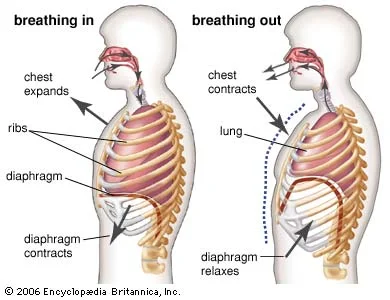
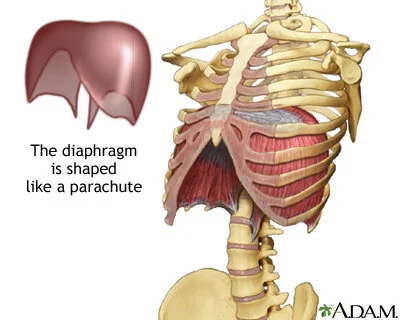
The diaphragm is the main respiratory muscle for breathing. To make sense of it, picture it as a parachute. Upon inhalation, the parachute will compress and descend downwards, pulling air into the torso. And then, with the help of the core musculature, it will ascend and push air out of the body (see below).

When you breathe correctly, the body should expand horizontally in all directions, not just the stomach. The rib cage, chest, and spine must expand to allow the lungs to fill with air. Next, the sides, back, and stomach will expand due to the inhalation of oxygen. Does that make sense? If not, close your eyes and think of an empty balloon. Now, imagine the balloon being filled up with air. Does the air in the balloon push into the front side only, or does it fill everywhere? If that still didn’t make sense, then the video below should clear some things up.
According to my clients, breathing into the backside is the most challenging. I have found the two exercises below to be very helpful. They will help you learn how to breathe into your whole core, not just the belly. With the improved breathing pattern, posture and core strength will improve. Breathing isn’t the sexiest or most exciting thing, but it is one of the most important things. Deep breathing is no different than any other skill. It just requires practice.
Reduce The Risk For Lower Back Pain
America is an injured nation. The total costs of low-back pain in the United States exceed $100 billion per year (1). I have seen this firsthand as a trainer. The majority of my clients have experienced back pain or currently have back pain. Back pain can be broken down into two categories: extension intolerant or flexion intolerant.
America is an injured nation. The total costs of low-back pain in the United States exceed $100 billion per year (1). I have seen this firsthand as a trainer. The majority of my clients have experienced back pain or currently have back pain. Back pain can be broken down into two categories: extension intolerant or flexion intolerant.
Are you extension or flexion intolerant?
To figure out which one you have you need to complete two tests. If you are extension intolerant then the child pose posture below will feel better than the upward dog posture. Once you know which posture is causing your back pain than you can reduce your back pain by avoiding that position

Upward dog

Child pose
For today's blog post, we will focus on extension intolerant back pain. This means that you prefer to be in the child's pose position versus the extended upward dog position.
Form Follows Function
I believe most back injuries are due to poor body alignment and muscular imbalances. In order for the body to function properly, it must be in the correct alignment. When the body is out of alignment, the muscles of the hip and trunk are affected. The glutes, abdominals, and hamstrings become weak forcing the lower back to do all the work.
A study done in the Journal of Physical Therapy Science supports this idea. Seventeen healthy adult males volunteered to take part in the study. The subjects muscle activity and spinal curve were measured during different postural conditions (neutral, sway-back, and lordosis).

As you can see from the chart below, the lumbar erector spinae muscle activity increased three-fold in a lordosis (excessive lower back arch) posture versus a neutral posture. While the gluteus maximus muscle fiber activity reduced two-fold (2). An inactive core combined with an overactive lower back is the perfect recipe to increase one's risk for injury.
The idea that an excessive lower back arch can increase the risk for back pain is supported by CJ Sorensen and colleagues (3). Their goal was to examine the effects lumbar lordosis has on back-healthy participants who do and do not develop low back pain during two hours of standing. Twenty four of the 57 participants who reported back pain also had an increased lower back arch.
The authors found an increased lumbar lordosis to be a risk factor for low back pain (3). Put simply, the participants who had an increased lumbar lordosis experienced more pain during standing versus the group with less lumbar lordosis. Therefore, to alleviate back pain we must bring the body back to proper alignment.

To reverse an anterior pelvic tilt, you must strengthen the deep abdominal muscles, glutes, and hamstrings. When they become stronger, they are able stabilize the pelvis by tilting the pelvis backwards. Also, inhibiting the latissimus dorsi, quadratus lumborum, and hip flexors through breathing, stretching and foam rolling can help too. In essence, you need to strengthen the muscles that tilt the pelvis posteriorly and relax the muscles responsible for tilting the pelvis anteriorly.
Stop Stretching Tight Hamstrings!
Over the last seven years, I have completed close to 10,000 hours of training. I have come to realize that the majority of people are out of alignment and lack the ability to maintain good posture.
CHECK POSTURE BEFORE STRETCHING
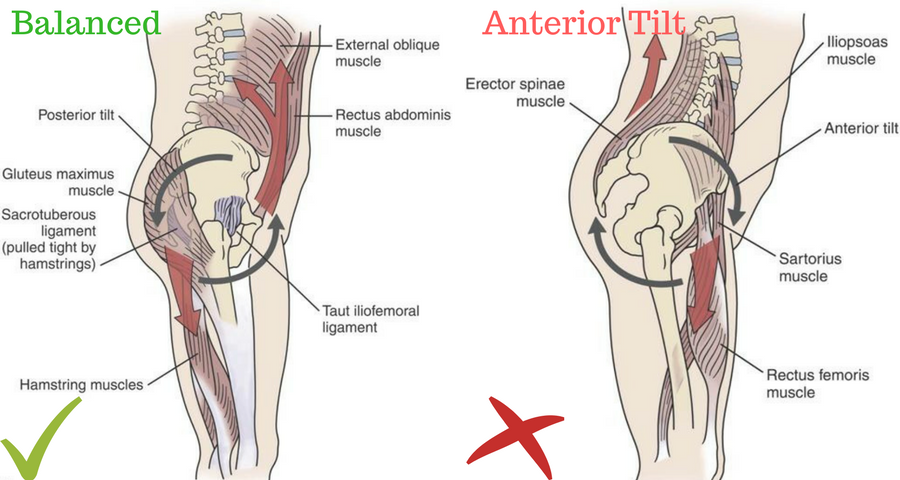
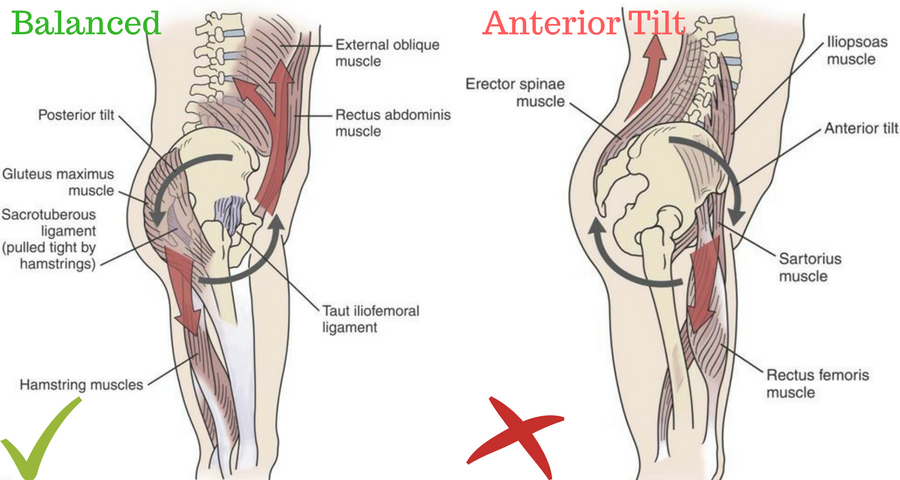
Over the last seven years, I have completed close to 10,000 hours of training. I have come to realize that the majority of people are out of alignment and lack the ability to maintain good posture. They are stuck with a pelvis and a torso that tilts too far forward (see below).
The anterior pelvic tilt is natural, but it can become problematic when it becomes excessive. The hamstrings are attached to the backside of the pelvis. Think of the pelvis like a pulley. When the pelvis tilts too far forward, the hamstrings have to lengthen to compensate for that imbalance (see above). The brain senses this stretched state and contracts the hamstrings to prevent tearing. Granted, the hamstrings aren’t alone in this job. The glutes, obliques, and deep abdominal muscles also play a key role in pelvic stability. Therefore, we can’t just stretch every tight muscle in our body.
What Is Ideal Posture?
Before stretching the hamstrings, we need to assess the situation and see if our body is in proper alignment. There should be a natural arch in the lower back and slight rounding of the upper back. The ear, shoulder, rib cage, hip, knee, and ankle should be stacked on top of each other. When the body is stacked and in alignment, the core musculature can do its job and stabilize the trunk.
Take a look at the picture above. How do you compare to the photo? Does your pelvis tilt too far forward? If so, then you need to fix the alignment first before stretching the hamstrings. Remember, just because something feels tight doesn't mean you need to stretch it; you might just need a stronger core.